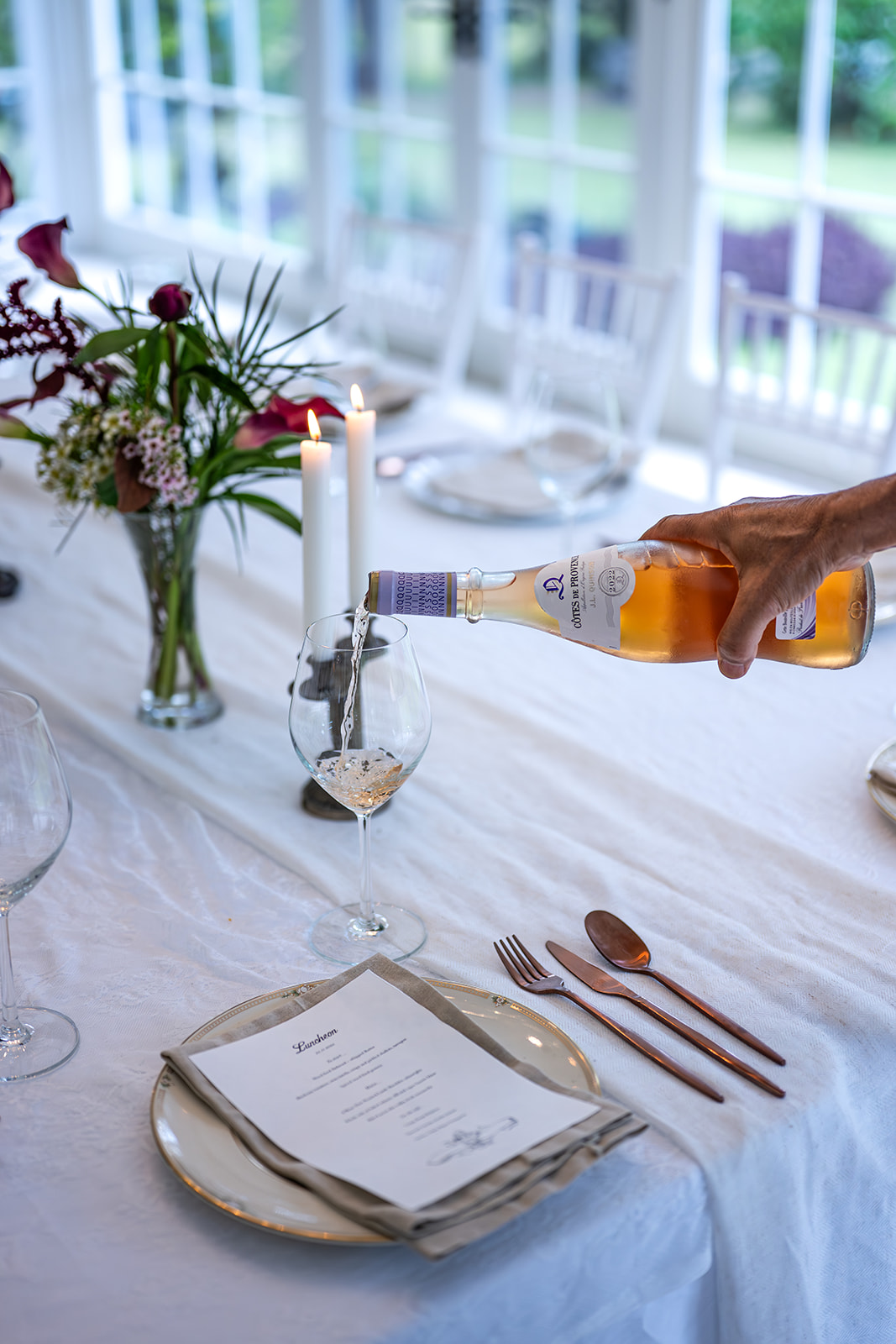
It is one of the first things couples start sketching out once the guest list is finalised, a grid of tables, names slotted into seats, hours spent moving people around so no one is sitting next to the wrong cousin. It feels like a non-negotiable part of planning a wedding.
For a lot of our couples, it is not necessary at all.
It is not really about the number
The honest answer to "do we need a seating chart" has less to do with how many guests you have and more to do with the shape of the night itself.
If your cocktail hour is short and guests are seated for most of the evening, assigned seats make sense. There is not enough time for people to find their own way to a group that feels right, so you are better off doing that work for them in advance.
But a lot of the weddings that feel the most alive are built the other way around. Guests arrive, there is a long, relaxed stretch of mingling before anyone sits down, drinks, canapés, wandering the gardens, conversations that start with one group and end with another. By the time it is actually time to sit for the meal or the speeches, people are not sitting as long as everyone assumes. Most of the night has already happened standing up, moving around, talking to people they would not have sat next to on a chart.
Under about 40 guests, that relaxed stretch is usually all you need.
What happens during that window
Left alone with enough time, people sort themselves. Friends who have not seen each other in a year find each other again. Your partner's old university friends end up deep in conversation with your cousins. By the time dinner is called, natural little clusters have already formed, and when it is time to sit, people flow into the seating area and settle in without being told where to go.
It looks effortless because, by that point, it is. The sorting already happened. All a seating chart would do at that stage is undo some of it, splitting up a conversation that was working in favour of an arrangement decided weeks earlier on a spreadsheet.
What about tricky family dynamics
This is usually the first objection, and it is a fair one. Every family has a pairing or two that someone is quietly worried about.
In our experience, those situations work themselves out more often than couples expect, for the same reason the rest of the room does. A long mingling window before anyone sits down gives people the time and the space to simply not end up next to each other, without anyone having to engineer it. The handful of situations that genuinely need managing can usually be handled with a quiet word to the people involved beforehand, rather than a formal chart for the whole room.
If you have a guest list where the dynamics are more complicated than that, a chart is still the right call. It is worth being honest with yourself about which situation you are actually in.
The structure that actually matters
The weddings that feel the most relaxed are not the ones with the least planning. They are the ones with the least visible structure and the most invisible structure behind it.
What we mean by that is this: skip the seating chart, but do not skip the shape of the day. Guests should always know, without being told twice, that cocktail hour is winding down, that it is time to make their way to the garden or the table, that the speeches are about to start. That comes from a clear program, a few well-timed cues from your MC or coordinator, and a day that moves with intention from one moment to the next.
It is the difference between a wedding that feels unplanned and one that feels unstructured in exactly the right places. The first one is chaos. The second one is the whole point.
Where we land
At The Singing Heart Estate, most of our full wedding receptions sit between 20 and 40 guests (our elopements are a different format with their own guest count and their own planning logic), and for the vast majority of them, we do not recommend a seating chart. What we focus on instead is the flow of the day itself, enough mingling time for the room to sort itself out, and clear, well-paced transitions so no one is ever wondering what happens next.
If your guest list is pushing past 40, or your day is built around a longer seated service, that calculation changes, and we will tell you so directly.
The Singing Heart Estate is a private French-inspired wedding estate on the Sunshine Coast, hosting intimate weddings and elopements